
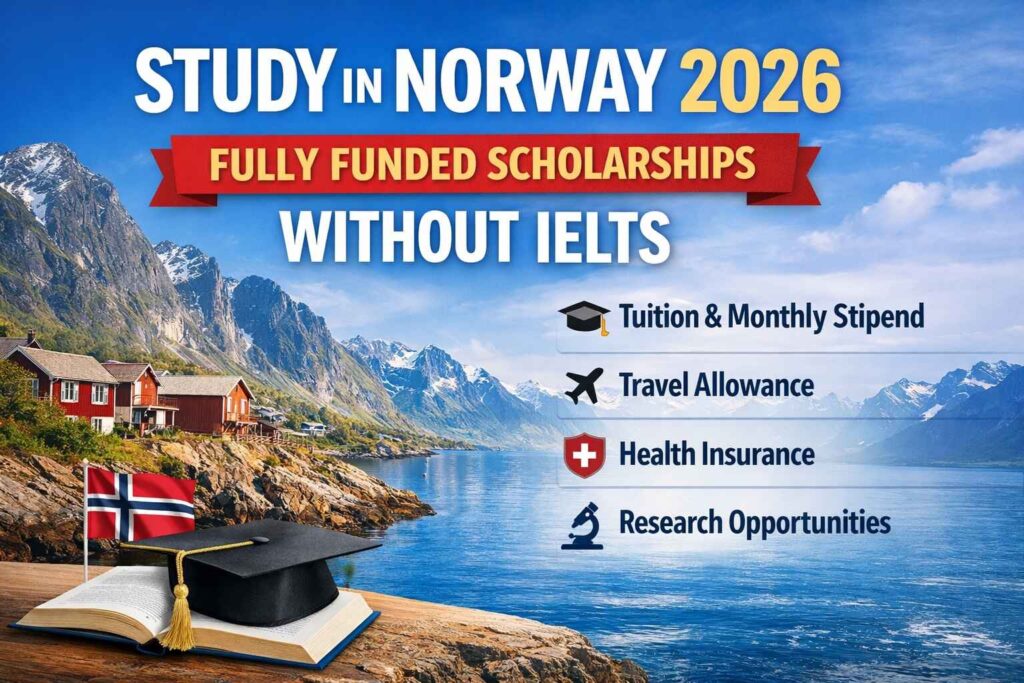

Norway is known for its world-class education system, high quality of life, and beautiful landscapes. If you’re considering studying in Norway, 2026/2027 could be the perfect time to take the leap, especially with a wide range of scholarships available for international students—without the need for IELTS!
In this article, we will explore everything you need to know about studying in Norway and the scholarship opportunities that don’t require IELTS. Whether you’re applying for undergraduate, master’s, or doctoral programs, there are multiple fully funded scholarships that can help you study in Norway without the stress of taking an English proficiency test.
Why Study in Norway?
Before diving into scholarships, let’s take a moment to highlight the reasons why studying in Norway is such a desirable option for international students:
- Quality Education: Norwegian universities and colleges offer top-tier programs, especially in fields like engineering, technology, medicine, sustainability, and business. Norway is home to some of the world’s best institutions such as the University of Oslo, Norwegian University of Science and Technology (NTNU), and BI Norwegian Business School.
- No Tuition Fees: One of the most attractive features of studying in Norway is that public universities do not charge tuition fees. This means that even if you receive a scholarship, you will only need to cover your living expenses.
- Stunning Natural Beauty: Known for its spectacular landscapes, including fjords, mountains, and the Northern Lights, Norway is an exceptional place to live, study, and explore.
- Focus on Innovation and Research: Norway is dedicated to cutting-edge research and innovation, especially in fields such as sustainability, renewable energy, and technology. The country places a high value on education, research, and the development of critical thinking.
Scholarships in Norway for 2026/2027 Without IELTS
If you’re looking to study in Norway and don’t want to go through the hassle of taking the IELTS exam, fear not! There are several scholarship options available for international students where English proficiency can be proven in alternative ways. Let’s dive into the scholarships that might be available to you.
1. The Norwegian Government Scholarship Program (Quotas Scheme)
The Norwegian Government Scholarship Program is a popular scholarship opportunity for students from developing countries. This scholarship covers tuition, living expenses, and travel costs. While IELTS is typically not a requirement for this program, applicants may need to provide evidence of English proficiency through other means, such as:
- A previous degree taught in English
- A letter from the institution confirming English language proficiency
Eligibility:
- Students from specific countries in Africa, Asia, and Latin America
- Undergraduate and postgraduate students
- Proof of previous education in English (if no IELTS)
Coverage:
- Full tuition fees
- Living expenses
- Travel costs to and from Norway
2. University of Oslo – International Scholarships
The University of Oslo offers several scholarships for international students, especially for students pursuing Master’s and PhD programs. Although the university typically asks for proof of English proficiency, alternative proof like a letter from your previous institution stating that your previous education was in English can be accepted. Some students may even be exempt from English language requirements altogether.
Eligibility:
- Master’s and PhD applicants
- Students who can demonstrate English proficiency through prior education
- Highly motivated individuals with an interest in research
Coverage:
- Full tuition fees (if applicable)
- Living expenses stipend
- Travel allowance
3. Norwegian University of Science and Technology (NTNU) Scholarships
NTNU offers a range of scholarships for international students wishing to pursue undergraduate, master’s, or doctoral degrees. While some programs may require proof of English proficiency through IELTS, many NTNU scholarships accept other forms of evidence, such as:
- Previous education conducted in English
- Certificates or diplomas from English-medium institutions
NTNU is particularly known for its STEM programs, making it an excellent choice for students interested in engineering, computer science, and renewable energy.
Eligibility:
- International students (non-EU/EEA)
- Master’s degree applicants
- Evidence of English proficiency through prior academic background
Coverage:
- Full or partial tuition fee coverage
- Stipend for living expenses
4. BI Norwegian Business School Scholarships
BI Norwegian Business School is one of Europe’s largest and most innovative business schools. They offer several scholarships for international students to study undergraduate and master’s programs. While IELTS scores are often accepted, proof of English proficiency from previous education or the completion of courses in English may suffice.
Eligibility:
- Open to international students
- Students with strong academic records
- Bachelor’s or Master’s programs in Business Administration, Finance, and more
Coverage:
- Tuition fee coverage (partial or full)
- Living expense allowances
5. Erasmus+ Scholarships for Norway
The Erasmus+ Program provides scholarship funding for European students and students from partner countries. These scholarships allow students to study in Norway for part of their degree program. Erasmus+ does not always require IELTS scores, and proof of English proficiency can often be demonstrated via previous academic qualifications or by providing a language certificate from your home university.
Eligibility:
- European Union students or students from specific partner countries
- Students enrolled in Erasmus+ exchange programs
- Applicants who meet the language requirements of the exchange program
Coverage:
- Full tuition fees (if applicable)
- Travel and living expenses
- Additional allowances for specific study fields
Alternative Proof of English Proficiency for Studying in Norway
While IELTS may be the most commonly used test for English proficiency, Norwegian universities are flexible when it comes to proving your language skills. In many cases, universities will accept other forms of proof, such as:
- English-medium secondary or higher education: If you’ve completed a degree or secondary school in English, you can submit your transcripts or a statement from your institution.
- TOEFL or Cambridge English Certifications: Some Norwegian universities accept other English proficiency exams like TOEFL or the Cambridge English exams.
- Language proficiency letter: If your previous institution can confirm that your education was conducted in English, you can provide this letter as proof.
Be sure to check the specific English language requirements for the university or scholarship you are applying to, as requirements can vary between institutions.
How to Apply for Scholarships in Norway 2026/2027 Without IELTS
- Choose Your Program and University: Begin by exploring the academic programs offered by Norwegian universities. Check if your chosen program offers scholarships or financial aid.
- Prepare Your Application Documents: Gather your academic transcripts, proof of English proficiency (from previous education), a well-written motivation letter, and any other documents required by the scholarship program.
- Apply for Scholarships: Visit the university’s official website to apply for available scholarships. Some programs require you to apply directly through the university’s application portal, while others may be part of national or government scholarship schemes.
- Submit Your Application Before the Deadline: Be mindful of application deadlines, which can vary depending on the university and scholarship program. Early applications are often encouraged.
Study in Norway in 2026/2027 Without IELTS
Norway offers incredible opportunities for international students, with scholarships that cover everything from tuition fees to living expenses. The best part? You don’t always need IELTS to prove your English skills! With alternative options for demonstrating proficiency, studying in Norway is more accessible than ever.
So, if you’re ready to embark on your academic journey in one of Europe’s most innovative and beautiful countries, don’t wait—apply for scholarships in Norway today and make your dreams of studying abroad a reality!