
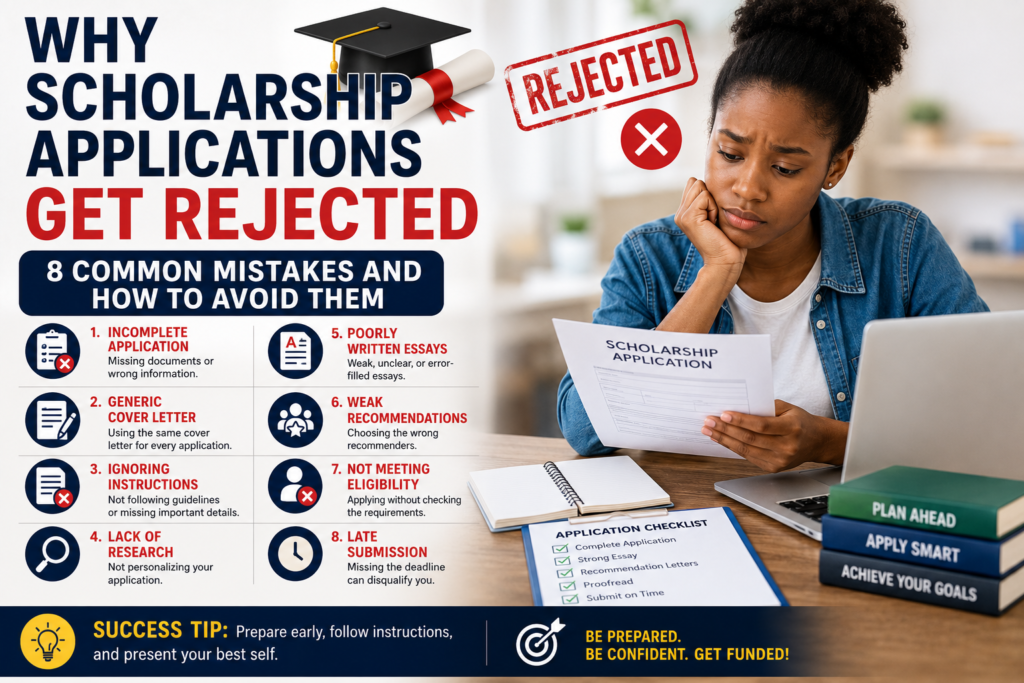
Applying for scholarships can open the door to studying abroad without financial stress. However, thousands of students lose scholarship opportunities every year because of simple mistakes in their applications. Whether you are applying for scholarships in Europe, the USA, Canada, Australia, or Asia, avoiding these common scholarship application mistakes can significantly increase your chances of success.
In this guide, we will discuss the 9 most common scholarship application mistakes and provide expert tips on how to avoid them for a successful application in 2026.

Why Scholarship Applications Get Rejected
Scholarship committees receive thousands of applications from students worldwide. Even highly qualified applicants can be rejected because of avoidable errors such as incomplete documents, weak motivation letters, or missing deadlines.
Understanding these mistakes can help you submit a strong, professional, and competitive scholarship application.
1. Missing the Scholarship Deadline
One of the biggest mistakes students make is submitting applications late. Scholarship deadlines are strict, and late applications are usually rejected automatically.
How to Avoid It
- Create a scholarship calendar
- Set reminders weeks before deadlines
- Prepare documents early
- Submit applications at least 3–5 days before the deadline
SEO Keywords
- scholarship deadlines
- missed scholarship deadline
- scholarship application tips
2. Submitting Incomplete Documents
Many students forget to upload important documents such as transcripts, recommendation letters, or language certificates.
Common Missing Documents
- Passport copy
- Academic transcripts
- CV/Resume
- Motivation letter
- Recommendation letters
- English proficiency proof
How to Avoid It
Create a checklist for every scholarship application and double-check all uploaded files before submission.
3. Writing a Weak Motivation Letter
Your motivation letter or personal statement is one of the most important parts of your scholarship application. A generic or poorly written letter can reduce your chances of selection.
Common Problems
- Copy-pasting templates
- Grammar mistakes
- Lack of personal story
- No clear goals
How to Write a Strong Motivation Letter
- Explain your academic goals
- Show leadership and achievements
- Mention why you chose the university
- Keep it personal and professional
SEO Keywords
- scholarship motivation letter
- personal statement for scholarship
- scholarship essay tips
4. Ignoring Scholarship Eligibility Requirements
Many students apply without carefully reading the eligibility criteria.
Examples of Eligibility Requirements
- Specific nationality
- Age limits
- Required GPA
- Language proficiency
- Degree background
Applying when you do not meet the requirements wastes time and may affect future applications.
How to Avoid It
Always read the official scholarship guidelines carefully before applying.
5. Using the Same Application for Every Scholarship
Every scholarship has different goals and selection criteria. Sending the same application everywhere is a common mistake.
Why It Hurts Your Application
Scholarship committees can easily recognize generic applications that are not customized.
How to Avoid It
Tailor your:
- Motivation letter
- Research proposal
- Scholarship essay
- Career goals
for each scholarship program.
6. Poor Grammar and Spelling Mistakes
Grammar errors make applications look unprofessional and careless.
Common Errors
- Spelling mistakes
- Incorrect formatting
- Informal language
- Long confusing sentences
How to Avoid It
- Proofread multiple times
- Use grammar-checking tools
- Ask teachers or friends to review your application
SEO Keywords
- scholarship writing mistakes
- scholarship application errors
- grammar mistakes in scholarship essays
7. Not Following Instructions
Some students ignore word limits, file formats, or application instructions.
Examples
- Uploading PDF instead of DOCX
- Exceeding essay word limits
- Incorrect file naming
These mistakes may lead to automatic rejection.
How to Avoid It
Read all instructions carefully and follow them exactly as requested.
8. Fake Information or Exaggerated Achievements
Providing false information can permanently damage your academic reputation.
Examples
- Fake certificates
- Edited transcripts
- False work experience
- Plagiarized essays
Why Honesty Matters
Universities and scholarship providers verify documents carefully.
Best Practice
Always provide accurate and truthful information.
9. Applying to Too Few Scholarships
Many students apply for only one or two scholarships and lose opportunities.
Why This Is a Mistake
Scholarships are highly competitive. Applying to multiple programs increases your chances of success.
Smart Strategy
Apply to:
- Government scholarships
- University scholarships
- External funding programs
- Regional scholarships
Bonus Tips to Increase Scholarship Success in 2026
Start Early
Begin preparing at least 6–12 months before deadlines.
Build a Strong Profile
Improve:
- Academic performance
- Volunteer work
- Leadership activities
- Research experience
Prepare English Proficiency Alternatives
Many scholarships now accept:
- MOI (Medium of Instruction)
- Duolingo English Test
- Online interviews
Final Thoughts
Winning a scholarship is not only about having excellent grades. Avoiding common scholarship application mistakes is equally important. By preparing carefully, following instructions, and submitting a professional application, you can improve your chances of studying abroad with financial support.
Scholarships in 2026 are becoming increasingly competitive, so students must focus on quality, accuracy, and preparation.
Start early, stay organized, and apply smartly to maximize your scholarship success.
Frequently Asked Questions (FAQs)
What is the most common scholarship mistake?
Missing deadlines and submitting incomplete applications are the most common mistakes.
Can grammar mistakes affect scholarship selection?
Yes. Grammar and spelling errors can make your application look unprofessional.
Is it okay to use the same motivation letter for every scholarship?
No. Each scholarship application should be customized according to the program requirements.
How many scholarships should I apply for?
Apply for as many relevant scholarships as possible to improve your chances.
To get Daily update Join our Telegram